
The Raasay Land Raiders / Rèidearan Ratharsair
For generations, the people of Raasay lived from the land. Families depended on crofts, small plots that provided potatoes, oats, and grazing for a few cattle. Life was shaped by the rhythm of the seasons, and neighbours relied on each other, sharing tools, labour, stories, music, and knowledge passed down.
The land wasn’t just where people lived, but part of who they were.
Most crofters held only a few acres, and families often supplemented their income with fishing or seasonal work on other islands or the mainland. The eighteenth and nineteenth centuries brought profound change to this way of life.
The Jacobite loss at the Battle of Culloden in 1746 accelerated the decline of the clan system, as the British government sought to dismantle traditional Highland society. The wearing of Highland dress and the carrying of arms were banned, as was the speaking of the Gaelic language, and the power of clan chiefs was curtailed.
What had once been a system based on kinship and mutual obligation was transformed into one where chiefs increasingly acted as landlords, treating land not as a shared resource but as private property to be managed for profit. Raasay’s thirteenth chief, John Macleod, was declared bankrupt in 1938 and relocated himself and his family to Australia and then Tasmania.
These changes coincided with the Abolition Act of 1833. This law ended slavery across most of the British Empire, but also compensated slaveowners for their financial losses. £20 million (modern equivalent of £17 billion) of British taxpayer money was paid out, not to the formerly enslaved, but to plantation owners. Beneficiaries of the compensation fund, who were looked down upon for their ‘new money’ redirected their wealth derived from slavery into a more noble capital; land in Scotland.
One such man was George Rainy (1790-1863), a prominent partner in the Sandbach, Tinne & Co. empire. Rainy bought Raasay and its surrounding islands in 1846 for 35,000 guineas. Although the first removal of people from Raasay had begun even before Rainy, during the time of the Macleods, it was under him that the most brutal clearances took place.
Rainy brought with him the same control tactics used to restrict and dehumanise enslaved people on his plantations to the people of Raasay, though without the same racial motivation, most infamously by forbidding marriage to prevent growth of population and by burning the shelter of a man who had defied him.
Around half the island’s population were evicted during his time, some by force, others driven out by the slow cruelty of manufactured poverty.
Families were scattered. Some went to the mainland, others were forced across the Empire.
We Were Promised /Chadh Gealltain Dhuinn
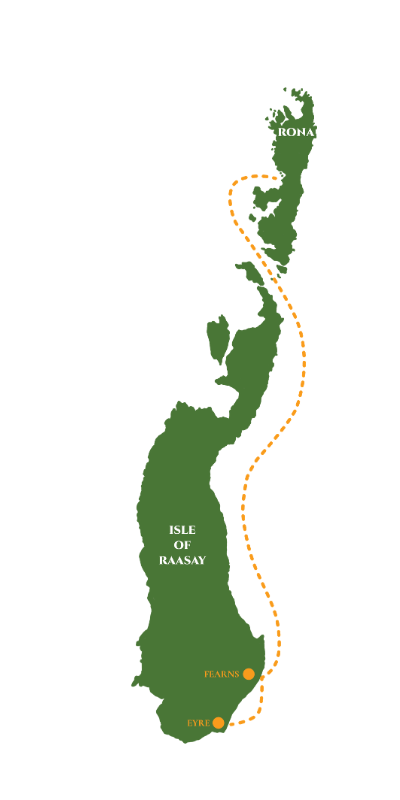
And yet, not all left. A determined, resilient minority were moved to the previously uninhabited parts of the north or to the neighbouring isles of Fladda, Eilean Tighe, and Rona. They held on fiercely to what remained of their homeland. There they stayed for over half a century. In that time, the quality and the quantity of the land worsened from overpopulation and the introduction of game animals, the rent increased, and less work became available. Before the introduction of national conscription, when the First World War broke out, many enlisted to fight overseas solely because politicians spoke of rewarding returning servicemen with a ‘LAND FIT FOR HEREOS’. Many of the men did not return home, but those who did returned to find their families enduring the same poverty, the same high rents, and the same poor, overworked soil as before.
Despite years of petitions and unsuccessful efforts to obtain the land by legal means, it became clear to the people of Rona that nothing would change unless they took action themselves.
As verbalised by the Shoemaker, John M. MacLeod, the people of Rona had always been careful to follow the law, they simply no longer recognised the legitimacy of laws made by, and for, distant landowners.
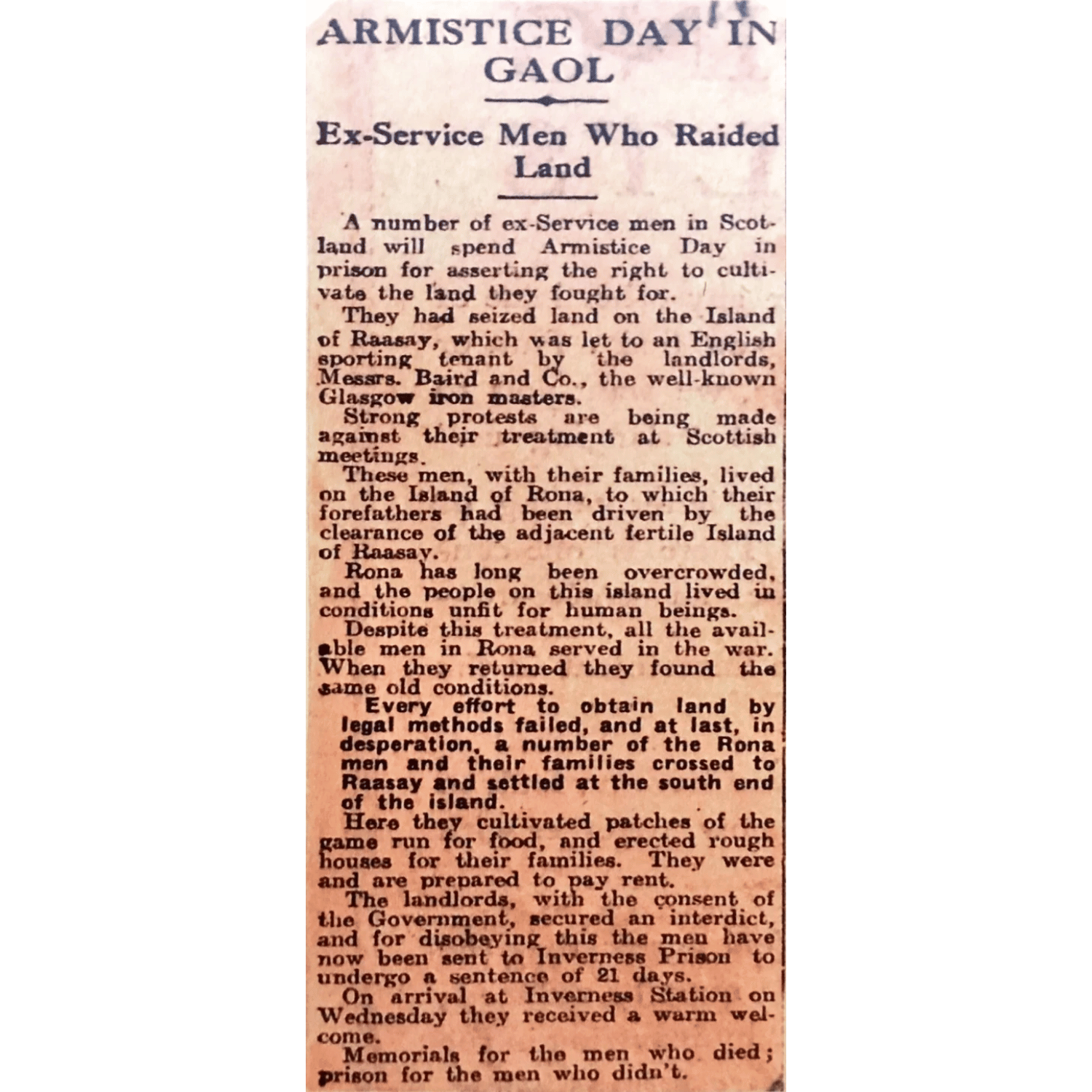
And so, in 1921, seven men from Rona took matters into their own hands. In the February, they had written forewarning local authorities, declaring their intentions to seize the land and their willingness to pay a fair rent. Then in the following months they rebuilt old structures and erected new houses, and begun planting crops on the soil. The raid was not violent, nor loud, nor boastful. They simply moved themselves and their families onto the land they longed to cultivate.
Coming Home / A’ Tighinn Dhachaigh
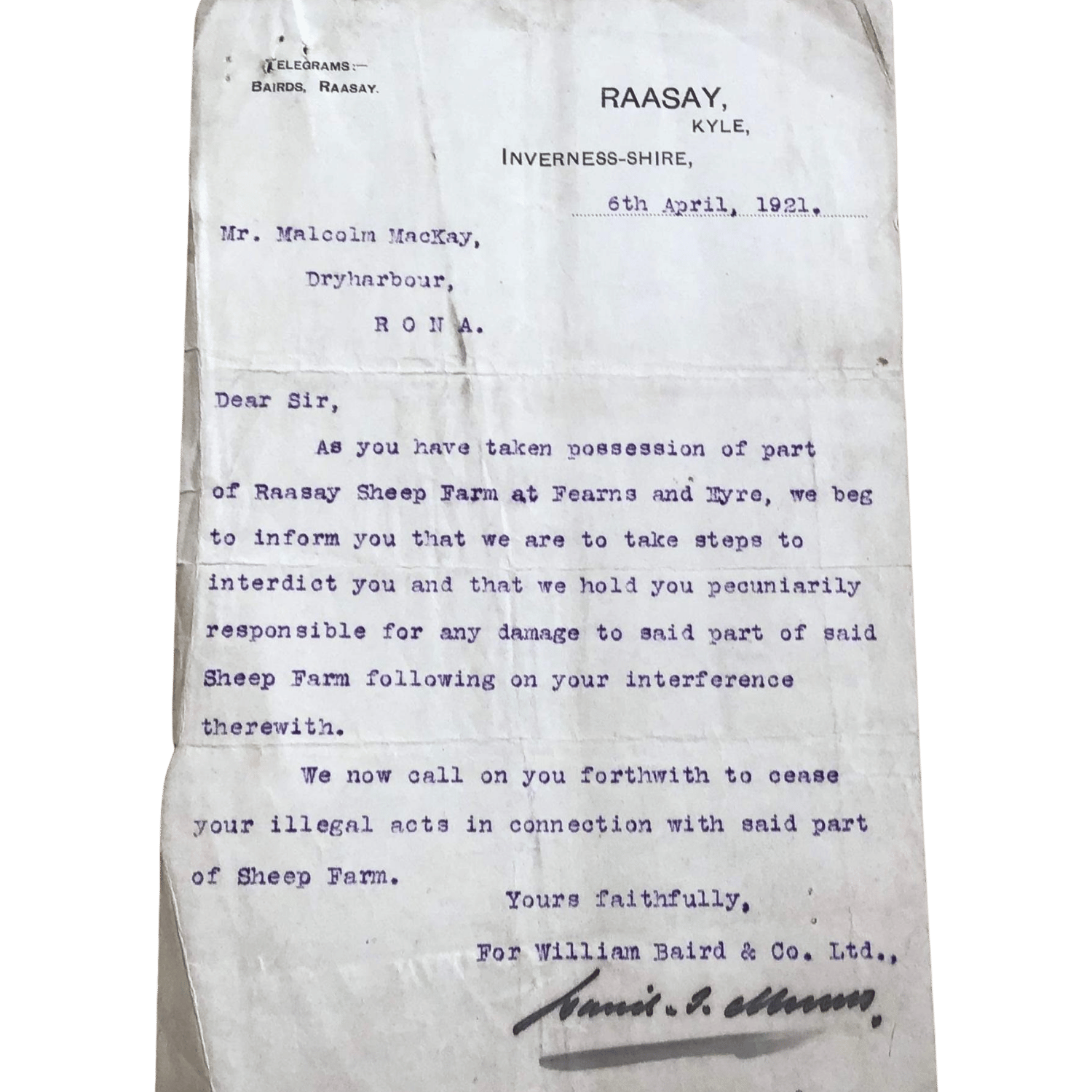
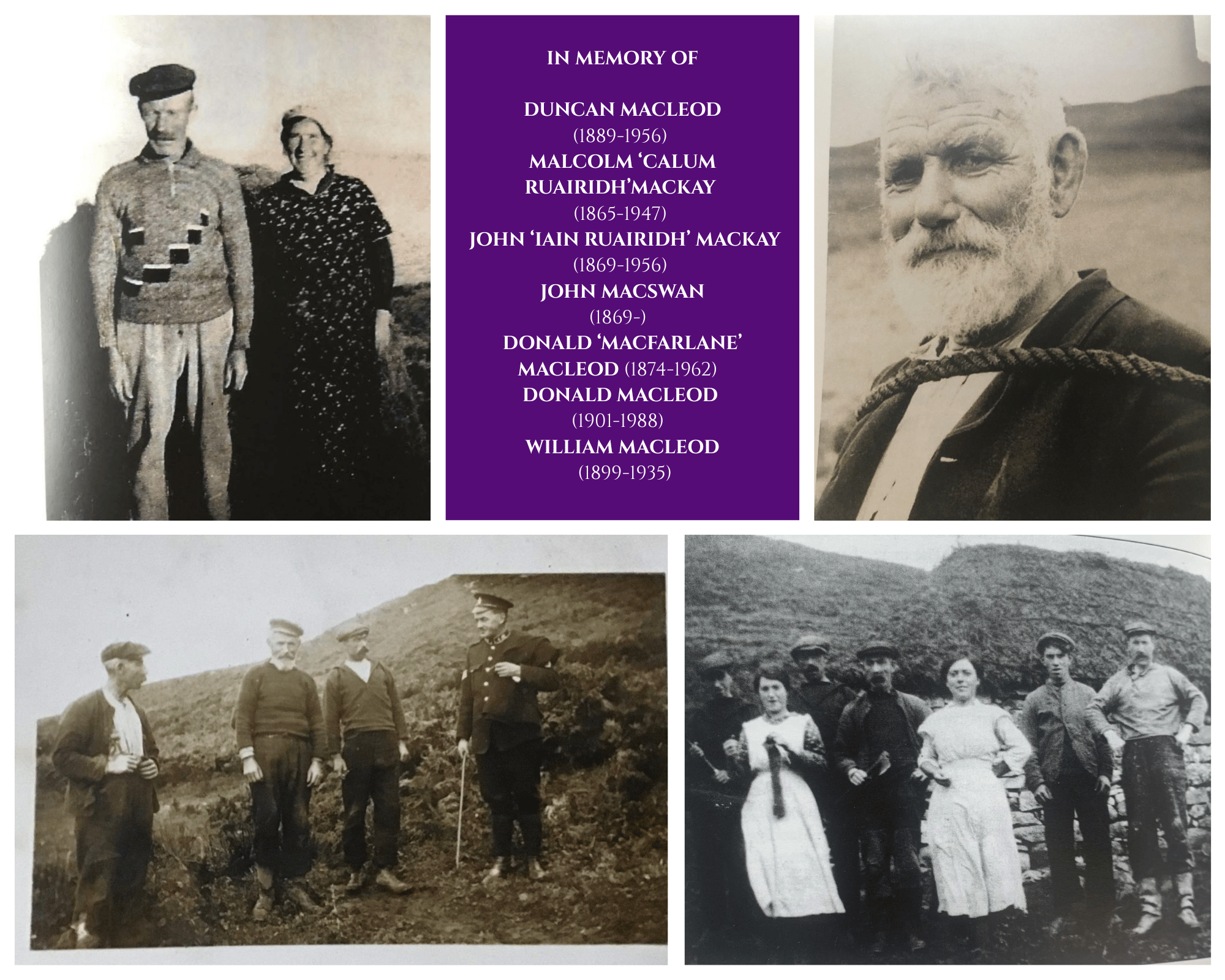
At the time, Raasay was owned by William Baird & Co. Ltd, who had operated the iron mines of the island during the war. By the time of the raid, the mines had ceased production, and the island was being let to an English sporting tenant. When the seven men settled in Fearns and Eyre, they received telegrams from the company ordering them to leave. The Director of Land Settlement wrote that the Bairds felt ‘nothing for public opinion or for the fate of the raiders’ and that they were prepared to demolish any houses built. When ignored, police were sent to the island but were frustrated in their attempts as the men were always forewarned by a member of the community. The raiders faced the ordeal with sharp humour and quick wit, trading jokes as they evaded the police, yet beneath the laughter were seasoned veterans, hardened by war and its effects, who were utterly serious about their cause.
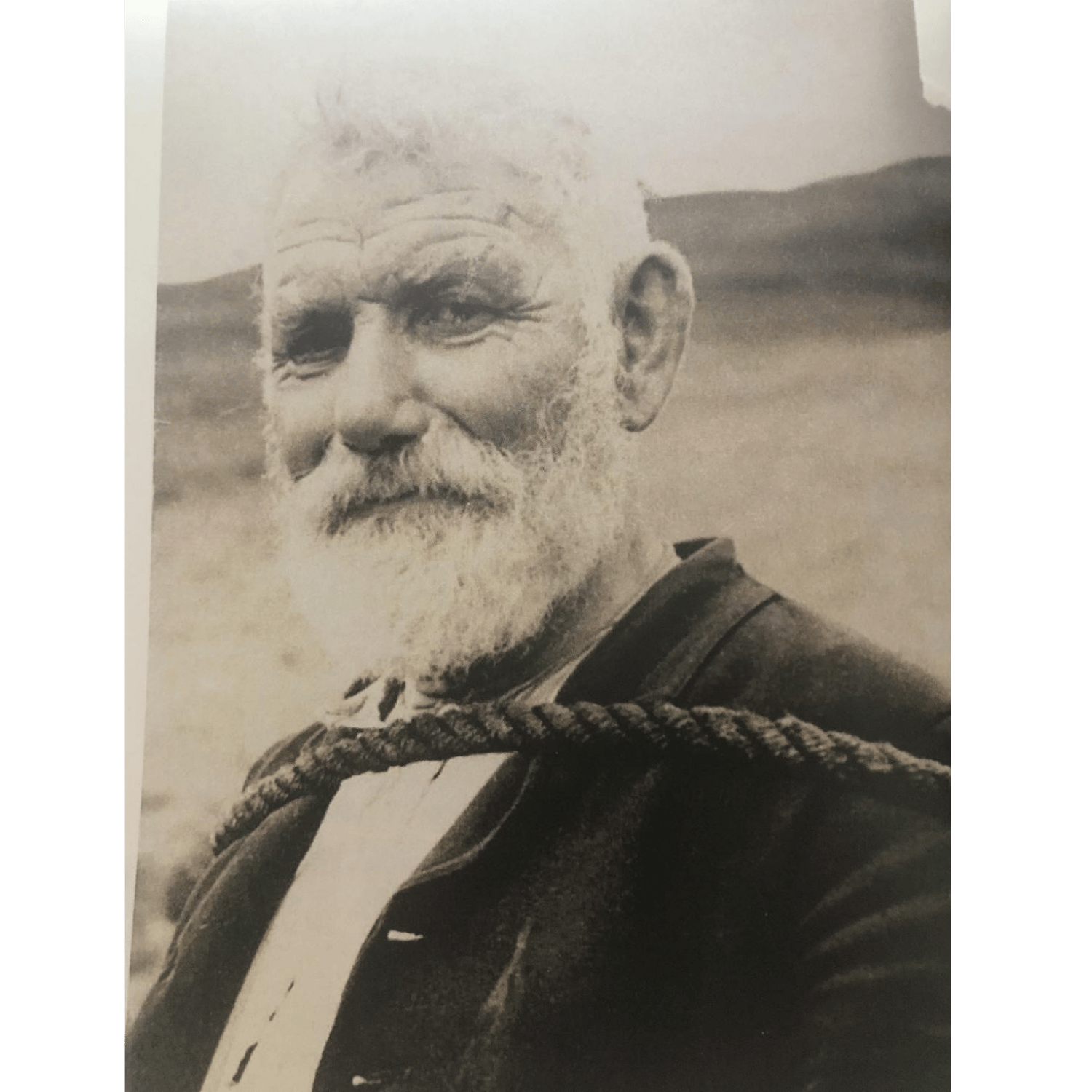
Islander Callum MacKay tells the story of his uncle, the raider John ‘Iain Ruairidh’ MacKay, and how the men would tease the officers;
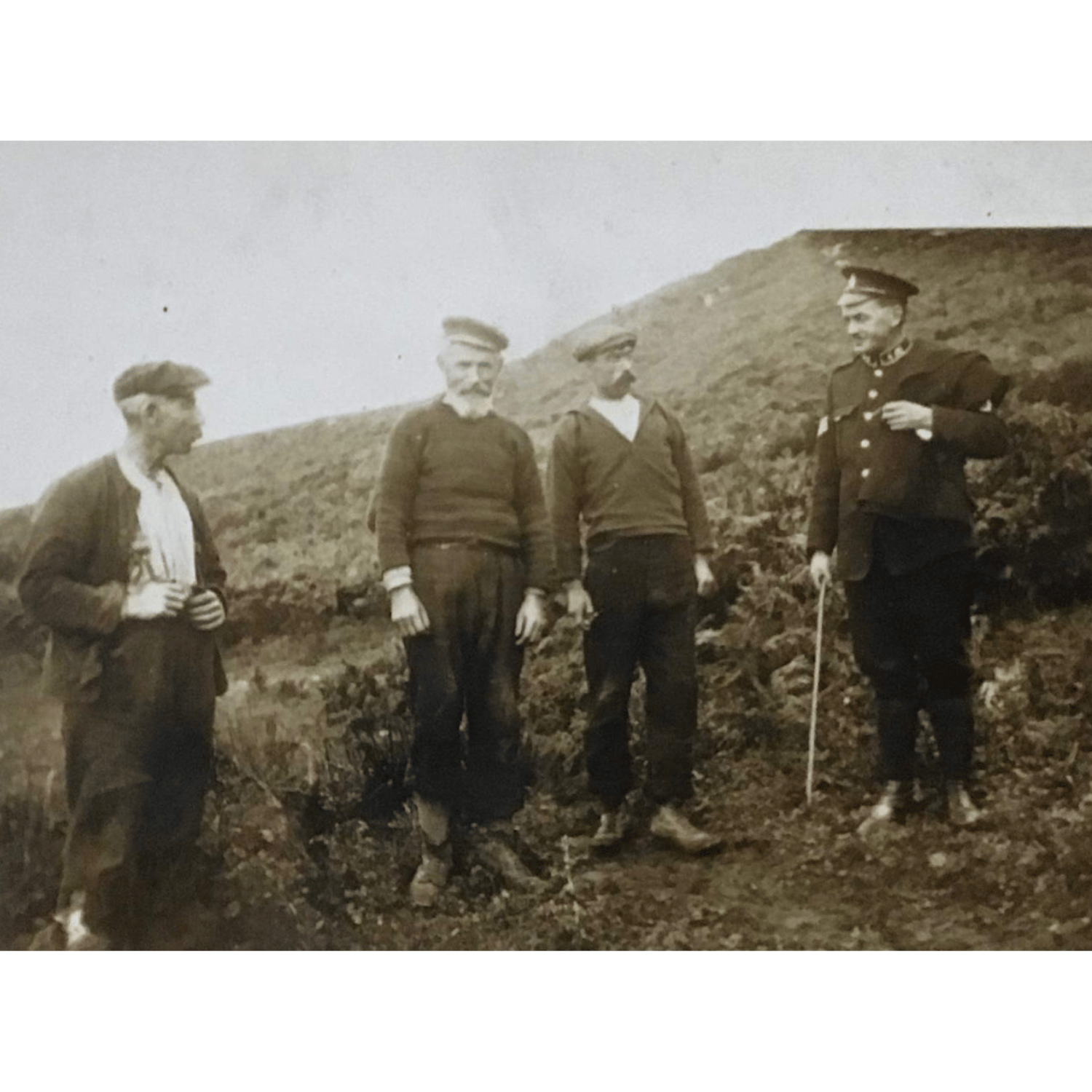
As the Raasay seizure progressed, the Skye police attempted to arrest the raiders but were frustrated in their attempts as the men were forewarned by a member of the local community. The raiders would leave ‘their houses, and they went on the hills d’you see, and they were watching the police at a distance… there was an uncle of mine John MacKay he was very… an ex-navy man and he was very impatient y’know and he would be peeping up going ‘too far away too far’ giving… exposing himself too much and one of the policemen stopped… spotted him y’know and he made after him so he would John MacKay would go a wee bit and he would say to the police ‘You needed come further’ he says ‘you’ll never catch me and even if you did’ he says ‘I wouldn’t go on that boat you have over there.’ ‘Why not?’ ‘I would put my foot through it’ he says ‘and sink the boat.’ ‘You would be drowned yourself’ says the policeman.
‘Not at all’ he says ‘I was in the Navy. I would swim the Channel.’
[Laughter]
So there was a hillock there where he was standing and the police was a bit away from him and we called it Cnoc a Phoileasmain, the hillock of the policeman, aye [laughter].
A Turning Point for Raasay / Am Cudromach Airson Eilean Ratharsair
The first arrests took place in the middle of the night on the 19th of September after the raiders had returned from taking Communion at the Free Church in Applecross. News of this spread quickly, and supporters from Skye, many of themselves ex-servicemen, hurried across to Raasay ready to block the police and even threatening to throw them into the sea. But the raiders refused to cause a scene and instead chose to go peacefully. They accepted their arrests on charges of breach of interdict and contempt of court. They spent several nights in the Portree jail before being moved to Porterfield Prison in Inverness. Represented by their lawyer, Donald Shaw, who had previously gained recognition for his work with the Vatersay Raiders, they were reportedly treated with great respect by sympathetic prison staff. Unlike other inmates, they were issued corduroy clothing rather than the standard white uniforms. While they were imprisoned, their wives and relatives wrote a plea to the Queen, Mary of Teck, requesting her attention to securing land for her subjects. The raiders’ stand and their families appeals evoked widespread public sympathy and their story was followed closely in newspapers across the country. Many remarked that while the dead of the war were being honoured with monuments and memorials, the surviving veterans were left to struggle in poverty and punished for their efforts to change that fate.
After the men were released, they again refused to return to Rona, and so were met on Raasay by a crowd of supporters led by a piper from Portree, who marched the raiders around Raasay House, in which the representatives of the Board of Agriculture were staying, and then to Fearns and Eyre. It proved their imprisonment had had no success in deterring them and the raiders remained determined to claim the land. The following year, in 1922, the island was purchased by the Department of Agriculture.
At last, each of the seven raiders was granted a croft: four at Fearns, and three at Eyre.
Over a century later, the story of the Raasay Land Raiders continues to resonate. Their story is more than an act of protest. It is a reminder of what it means to belong to a place. Their legacy is carried on by those who live and work on Raasay today, by the land itself, and by all those who remember them.
Follow Raasay History on Instagram for More Information
Isle of Raasay



Raasay.com is managed by Raasay Development Trust (RDT) on behalf of the Raasay community.
Photos credits: Calum Gillies :: David Carslaw :: Hannah Moore :: Copywriting: Linsay MacLean