
CNI Raasay: A Recap and Update
As it’s been a while since I’ve sent an update. I intend that this post can bring you up to speed on whats have been happening with Carbon Neutral Islands (CNI). As a reminder, Raasay was chosen to be Net Zero by 2040. Raasay was given choice of how to go about this. Everything we work on is linked to these priorities were chosen by the community back in early 2023 when we worked together to create the Community Climate Action Plan.
A quick recap on where we are with us. CNI has secured another year of funding for jobs and has just appointed another Community Development Officer after Carwyn’s departure from CNI. I would like to Thank Carwyn for all he contributed over the last 9 months, it was a pleasure to work with him. The role this year will work with Raasay Community Renewables to set up an Energy Local Club, allowing islanders to access energy at reduced cost while increasing income for the hydro.
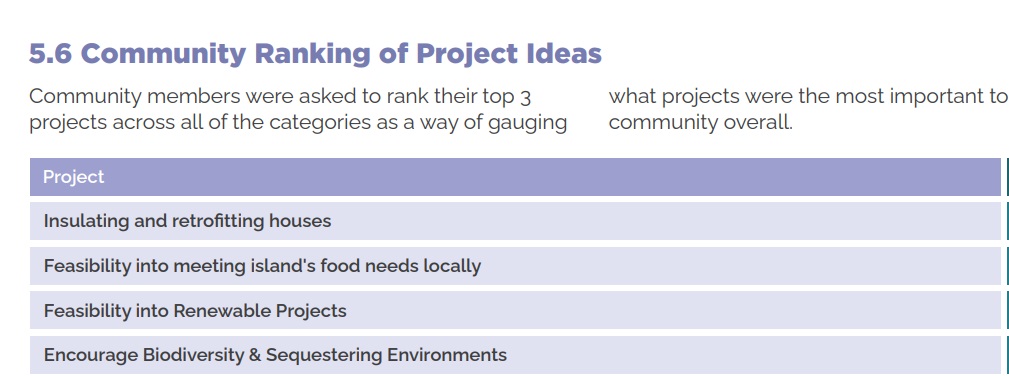
In 2023 when we asked what mattered – Retrofitting housing, more local food, more renewables, and looking after our wildlife, wildplaces and sea came out on top. Below is what we’ve done so far to address each, and what comes next.
If you have any questions, concerns or thoughts, you’re welcome to contact me on tom@raasaydevelopmenttrust.org or drop by the hall Friday 12th June 1pm-3pm .
Housing Retrofit – Warmer Homes
Retrofitting Housing was the top priority. To address this, we facilitated the first of its kind retrofit project in Scotland. Over 50 homes signed up for some form of measures, which is over half of the full-time occupied houses on Raasay. Insulation, Heatpump installations and energy efficiency improvements have been installed across these homes.
Alongside this, CNI contributed to and instigated a project to retrofit three Inverarish houses into social housing, with works expected to be completed later this year. Using a local contractor, Torr, means that the funding is reinvested back into island which has created considerable amount of jobs.
Heating our homes is one of the biggest sources of carbon emissions on Raasay meaning alongside warmer and more efficient homes it is a big step towards reducing emissions. Retrofitting existing buildings has a much lower environmental impact than building new.
There has been quite a lot of demand for another round of retrofit. If this emerges as a priority when we revisit the action plan this year, we’ll look into doing round two.
Renewables: Community buildings
To bring more renewable energy to the island we have been working with Raasay House Community Company and Raasay Outdoor Centre to explore retrofitting its heating from Gas boilers to a ground source heatpump (GSHP). Not only could this project save 3000+ tonnes of Co2e over the next 30 years, the savings would make the building cheaper to operate with a portion of the savings going to RHCC’s community benefit fund.
And if you’re thinking – aren’t renewables just wind turbines and solar panels? Technology like Ground Source Heat Pump’s(GSHP) can turn 1 unit of electric into 5 units of heat which means it gets classed a renewable heating source. The community hall has already had its heat pump and Solar PV upgrades and is our first Net Zero building. Installing renewables on community owned assets ensures the benefits stay on Island.
Designs for the system have been issued which we’re currently reviewing and evaluating before proceeding.
Increasing Local Food Production
As well as working alongside the walled garden to encouraging people to grow more of their own food. We’ve been working with the Raasay Crofters Association on a Venison Processing Facility. Converting the Old Suisnish Ferry Ticket office into a v facility means the island’s venison can be processed on Raasay, rather than being sent off the island and returned ensuring a regular supply to the island through the shop increasing the availability of a healthy food source.
Beyond tasty burgers and venison sausages, increasing island food resilience and skills opportunities this project has the potential to make a huge impact. Transport miles are reduced. And, 1kg of venison uses 55x less emissions that the equivalent beef, having sustainable grazing numbers on the hill is good for their welfare and is required if we are to reduce our land based emissions.
A funding application is in the process to fund this. This would be done using local contractor Torr, again ensuring jobs stay on the island.
Protecting Wildlife, Biodiversity and Carbon rich environments
A separate, more comprehensive post on the Habitat Restoration project work is coming, so I’ll keep it brief here.
The fourth priority was improving biodiversity and the surrounding environment. People said many things, from more protected areas for wildlife to more forests or marine protection. When we dug into it, one threat came up again and again: Rhododendron Ponticum, while beautiful, it takes over land killing wildlife, smoothers native plants, degrades the islands biggest carbon store, peatlands, and takes over woodlands, which take in vast amounts of carbon.
Training was offered to the community and a tender put out last January, since then a local team was setup and has been treating rhododendron across the island for over a year now clearing over half the area of Rhododendron so far and clearance rates consistently above 90%. The project has provided employment for three to five local contractors.
Trials have been done on Japanese Knotweed which have proved to be successful. As its been raised as a growing concern, over this summer a more extensive operation to treat Japanese Knotweed and we have submitted to a funding application to try enable its eradication island-wide. In addition the funding application would look to expand into more tree planting.
Why were these projects selected for this years funding?
With a tight government deadline of 22nd May only projects that were established, had previously got community support and, importantly, were already ready to go could be submitted . CNI funds are specifically for projects which have some amount of Carbon reduction.
Other things on the go
A few smaller pieces alongside the four big ones:
Working with Raasay Community Renewables, a direct wire has been funded to connect to the hydro to the distillery.
CNI has funded an e-bike scheme being set up by Raasay House, which will be available for the community to use at a reduced rate and for free when the bikes are not in use.
A community bus has been discussed – While it wasn’t a top priority of the action plan it has come up time and time again. As CNI couldn’t operate it the question has been raised about who and how would it be run so it’s not a drain on the island.
So, has it made a difference?
Carbon impacts are slow to measure, especially after only a few years. What can be said is these projects work address the biggest emission sources and if the island is to reach Carbon Neutrality it needs to keep going in this direction. Over the coming year we will look to dig deeper into what progress has been made and will continue to feed this back as learn.
What next?
It has been a few years since the Climate Action Plan was put together. We have planned for this year is to revisit it and see what is important for the island now. Priorities shift, and we want the next phase of CNI to reflect what the community wants today to ensure that CNI works with the island. This will be a chance for anyone to have their say.
Till the next time, All the best,
Tom